Best Pricing Models for AI Companies

The AI Pricing Renaissance
AI monetization is evolving faster than any category in software history. Companies are experimenting with dozens of pricing models, moving beyond traditional SaaS subscriptions to find approaches that better align with AI economics and customer value.
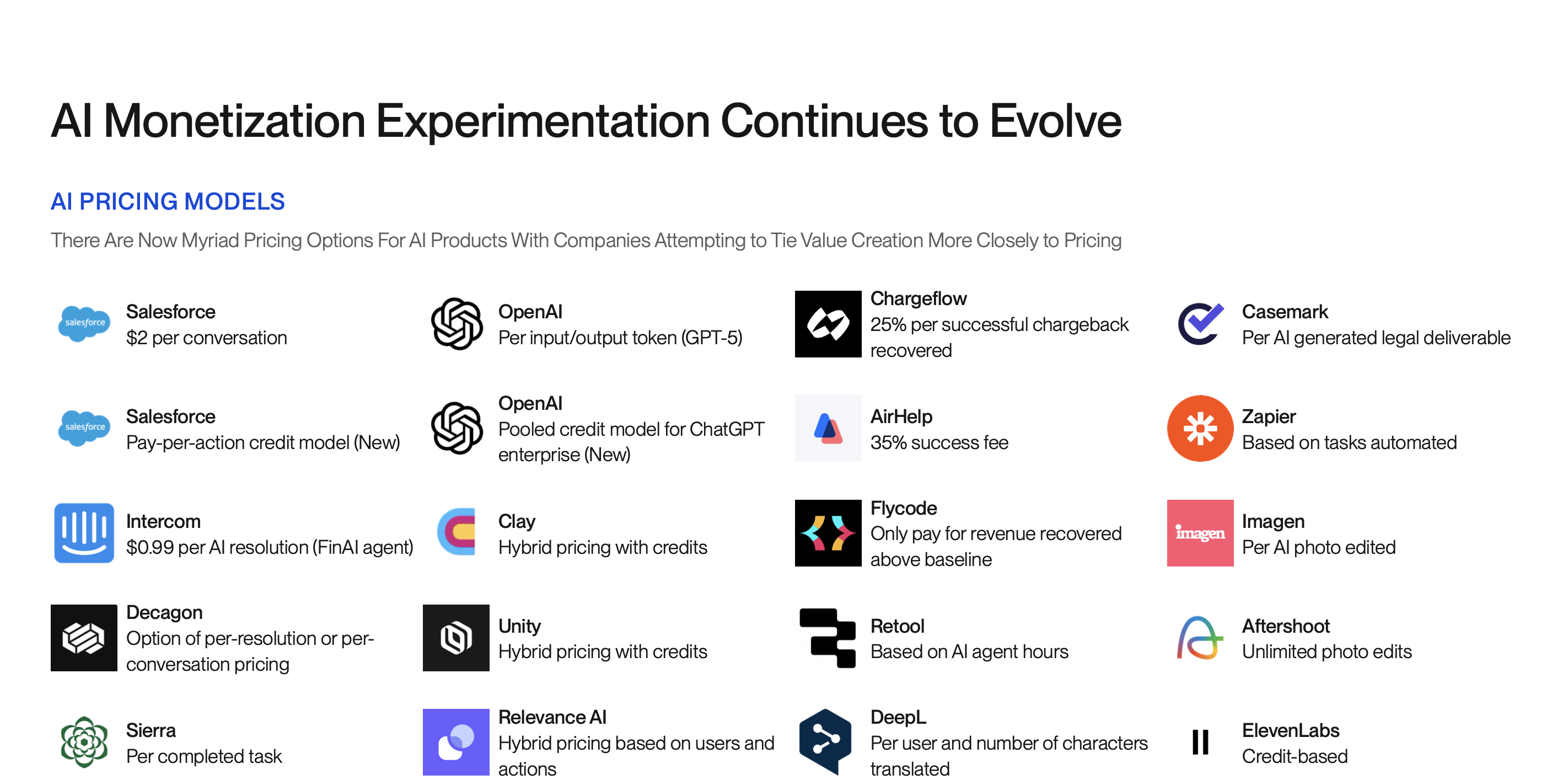
The image above from recent market analysis shows the diversity: outcome-based pricing, hybrid credit models, per-action fees, success-based charges, and consumption models ranging from tokens to agent hours to completed tasks.
This isn't chaos. It's experimentation at scale. The companies that win will be those that find pricing models matching their specific value proposition, cost structure, and customer preferences.
Here are the best pricing models for AI companies in 2025, when to use each one, and real examples of companies executing them successfully.
Token-Based Pricing: The Foundation Model Standard
What it is: Customers pay per input and output token processed by your AI model.
Best for: Language models, text generation APIs, translation services, and any AI product where value correlates directly with text volume processed.
Why it works:
- Aligns perfectly with infrastructure costs (you pay model providers per token)
- Easy for technical users to understand and predict
- Scales naturally from experimentation to production workloads
- Industry standard set by OpenAI, Anthropic, and other foundation model providers
Real examples:
- OpenAI: GPT-5 charges per input/output token with different rates for different models (GPT-4 vs GPT-3.5)
- Anthropic: Claude charges per million tokens with volume discounts
- DeepL: Charges per character translated, essentially token-based for translation
Pricing structure:
- $0.001 - $0.05 per 1,000 tokens depending on model quality
- Lower rates for input tokens, higher for output tokens
- Volume discounts at higher tiers (per million tokens)
Implementation tips:
- Clearly communicate token counting methodology
- Show real-time token usage in UI
- Offer token calculators so customers can estimate costs
- Consider different rates for different model tiers (basic vs premium)
Pros:✓ Direct cost-to-revenue alignment✓ Familiar to developers✓ Scales infinitely✓ No artificial usage limits
Cons:✗ Can be unpredictable for non-technical users✗ Requires extensive usage monitoring✗ Difficult for customers to budget precisely
Per-Action Pricing: Simplicity at Scale
What it is: Customers pay a fixed price per discrete action completed—per conversation, per resolution, per task, per photo edited.
Best for: AI products with clear, definable outputs where customers care about results, not underlying resources consumed.
Why it works:
- Incredibly simple to understand
- Customers know exactly what they're paying for
- Easy to predict costs based on volume
- Removes technical complexity from pricing discussions
Real examples:
- Salesforce Agentforce: $2 per conversation handled by AI
- Intercom Fin: $0.99 per AI resolution
- Sierra: Per completed task pricing
- Imagen: Per AI photo edited
Pricing structure:
- $0.10 - $5.00 per action depending on complexity
- Volume discounts for bulk usage
- Different pricing for different action types
Implementation tips:
- Define "action" clearly to avoid disputes
- Consider what constitutes a "successful" action
- Build in partial credit for failed actions
- Show action count prominently in dashboards
Pros:✓ Dead simple for customers to understand✓ Predictable budgeting✓ Removes technical abstraction✓ Scales naturally with customer value
Cons:✗ May not reflect actual cost variance between actions✗ Complex actions might be underpriced✗ Customers might game the system by batching
Outcome-Based Pricing: Charging for Results
What it is: Customers pay based on successful outcomes or value delivered—revenue recovered, successful chargebacks, problems solved.
Best for: AI products where value is measurable and directly tied to business outcomes rather than usage volume.
Why it works:
- Perfect alignment between customer success and your revenue
- Removes adoption risk (customers only pay for results)
- Justifies premium pricing when outcomes are valuable
- Differentiates you from cost-based competitors
Real examples:
- Chargeflow: 25% of successful chargeback amounts recovered
- AirHelp: 35% success fee on compensation claims
- Flycode: Only charges for revenue recovered above baseline
- Harvey AI: Success fees on legal outcomes in some contracts
Pricing structure:
- 15-35% of value created (recovered revenue, cost savings, etc.)
- Minimum fees to cover base costs
- Tiered percentages based on outcome size
Implementation tips:
- Define "success" unambiguously upfront
- Track outcome metrics religiously
- Consider hybrid models (base fee + outcome percentage)
- Be conservative on outcome attribution
Pros:✓ Zero risk for customers (they only pay for value)✓ Can command premium pricing✓ Natural incentive alignment✓ Powerful sales story
Cons:✗ Revenue is unpredictable✗ Complex to track and attribute✗ May not cover costs if success rates are low✗ Long sales cycles (customers want proof first)
Hybrid Credit Models: Flexibility Meets Control
What it is: Customers purchase credits upfront, then spend credits on various actions with different credit costs per feature.
Best for: AI products with multiple features at different value/cost levels, or companies wanting prepaid revenue with consumption flexibility.
Why it works:
- Combines prepaid cash flow benefits with usage-based flexibility
- Allows differential pricing across features
- Gives customers spending control
- Creates opportunities for promotions and bonuses
Real examples:
- Clay: Hybrid pricing with credits for enrichment actions
- Unity: Credits for different AI services
- Relevance AI: Credit-based system for users and actions
- ElevenLabs: Credit-based voice generation
Pricing structure:
- Credit packages: 1,000 credits ($10), 10,000 credits ($80), 100,000 credits ($600)
- Different features cost different credits
- Volume discounts on larger packages
- Optional credit expiration (60-90 days)
Implementation tips:
- Make credit-to-action mapping transparent
- Show real-time credit balance everywhere
- Enable auto-recharge at thresholds
- Send low-balance alerts proactively
- Consider bonus credits for larger purchases
Pros:✓ Upfront revenue and improved cash flow✓ Spending predictability for customers✓ Flexible feature pricing✓ Gamification opportunities
Cons:✗ Added complexity vs. simple per-unit pricing✗ Credit balance management overhead✗ Potential confusion about credit costs✗ Expiration policies can frustrate customers
Success Fee Models: Performance-Based Revenue
What it is: Customers pay a percentage of successful transactions or outcomes, similar to outcome-based but focused on transactional success.
Best for: AI products in sales, marketing, collections, or any domain where success is binary and measurable per transaction.
Why it works:
- Completely removes adoption risk
- You're directly incentivized to improve AI accuracy
- Premium pricing justified by performance
- Natural scaling as customer volume grows
Real examples:
- Retool AI agents: Success-based pricing for automated workflows
- Various AI sales tools: Percentage of closed deals
- AI collections platforms: Percentage of recovered debt
Pricing structure:
- 20-40% of transaction value for successful outcomes
- Minimum monthly fees for access
- Volume discounts at scale
Implementation tips:
- Define success criteria explicitly
- Track success rates transparently
- Consider hybrid (base + success fee)
- Cap total fees to avoid sticker shock
Pros:✓ Zero risk proposition for customers✓ Revenue scales with customer success✓ High trust signal✓ Competitive differentiation
Cons:✗ Highly variable revenue✗ Depends on AI accuracy✗ Complex tracking and reporting✗ May not cover fixed costs initially
Seat-Based with AI Credits: The Hybrid Approach
What it is: Traditional per-user pricing combined with allocated AI credits per seat or team.
Best for: AI features embedded in traditional SaaS products, or companies transitioning from pure SaaS to AI-enhanced offerings.
Why it works:
- Familiar pricing structure for traditional SaaS buyers
- Provides base revenue predictability
- Credits handle variable AI consumption
- Bridges old and new pricing paradigms
Real examples:
- Salesforce: Pay-per-action credit model for Agentforce (new approach)
- Notion AI: $8-10/user/month with usage included
- Many traditional SaaS adding AI: Base seat + AI credits
Pricing structure:
- $20-50 per user/month base subscription
- Includes X credits for AI features
- Additional credit purchases for heavy users
- Volume discounts on additional credits
Implementation tips:
- Clearly separate base features from AI credits
- Make credit allocation per seat visible
- Allow credit pooling across team
- Offer credit top-ups without forced upgrades
Pros:✓ Predictable base revenue✓ Familiar to existing SaaS customers✓ Handles AI cost variability✓ Easier enterprise sales
Cons:✗ More complex to explain and manage✗ Can feel like "nickel and diming" if not done well✗ Doesn't capture full upside of heavy AI users✗ Credit allocation can feel arbitrary
Agent Hours or Resource Time: Infrastructure Pricing
What it is: Customers pay for actual compute time, agent runtime hours, or infrastructure resources consumed.
Best for: AI products where costs are primarily driven by compute/runtime rather than discrete actions or outcomes.
Why it works:
- Direct alignment with your infrastructure costs
- Transparent cost-pass-through model
- Natural for technical audiences
- Scales with actual resource consumption
Real examples:
- Retool AI agents: Based on agent hours running
- Various AI development platforms: GPU hours consumed
- AI training platforms: Compute time pricing
Pricing structure:
- $0.05 - $2.00 per agent hour depending on capabilities
- Different rates for different resource tiers
- Volume discounts at scale
Implementation tips:
- Show real-time resource consumption
- Provide cost estimation tools
- Consider idle time policies
- Offer committed use discounts
Pros:✓ Perfect cost alignment✓ Transparent pricing✓ Familiar to infrastructure users✓ Easy to justify pricing
Cons:✗ Requires sophisticated metering✗ Can be unpredictable for customers✗ May discourage exploration/experimentation✗ Not value-based
Freemium with Unlimited: The Acquisition Model
What it is: Generous free tier with unlimited usage on basic features, paid tiers for advanced capabilities or higher limits.
Best for: Developer tools, APIs, and AI products where viral adoption and ecosystem growth matter more than immediate monetization.
Why it works:
- Removes all friction to getting started
- Drives ecosystem growth and network effects
- Monetizes power users while keeping hobbyists free
- Strong land-and-expand motion
Real examples:
- Aftershoot: Unlimited photo edits on free tier
- Many AI APIs: Free tier with rate limits
- Cursor/AI coding tools: Free tier for basic usage
Pricing structure:
- Free tier: 1,000-10,000 actions/month
- Pro tier: $20-50/month for higher limits
- Enterprise: Custom pricing
Implementation tips:
- Make free tier genuinely useful
- Clear upgrade path when users hit limits
- Usage visibility to encourage self-upgrade
- Consider time-based rather than volume limits
Pros:✓ Massive top-of-funnel growth✓ Low customer acquisition cost✓ Product-led growth motion✓ Community building
Cons:✗ Delayed monetization✗ High infrastructure costs on free users✗ Conversion rate risk✗ Requires scale to work
How to Choose the Right Pricing Model for Your AI Product
Selecting the optimal pricing model depends on multiple factors specific to your business:
Consider Your Cost Structure
High variable costs per action? → Token-based, per-action, or credit-based pricing to maintain margins
Low marginal costs? → Consider outcome-based or success fees where you can capture more value
Unpredictable cost variance? → Avoid flat pricing; use consumption models with volume discounts
Consider Your Customer Segment
Developers and technical users? → Token-based or API call pricing (familiar and expected)
Business users and executives? → Outcome-based or per-action (focuses on results, not technical details)
Enterprise customers? → Hybrid models with committed use discounts and predictable billing
Small businesses and individuals? → Credit-based for spending control, or simple per-action pricing
Consider Your Value Proposition
Measurable business outcomes? → Outcome-based or success fee models capture value best
Time savings or efficiency? → Per-action pricing that scales with automation volume
Quality or accuracy advantage? → Premium per-action pricing or outcome-based to justify higher prices
Infrastructure/platform play? → Token-based or resource-time pricing for cost-plus models
Consider Your Business Stage
Pre-product-market fit? → Simple pricing, generous free tier, maximize learning over revenue
Growth stage? → Consumption pricing that scales naturally with customer success
Mature/profitable? → Optimize pricing with volume discounts, committed use, and segmentation
Implementing Complex Pricing Models: The Atlas Advantage
The pricing models above range from simple to complex, but they all require robust infrastructure:
Real-time usage metering across multiple dimensions (tokens, actions, outcomes, time)
Flexible pricing logic that handles different rates, tiers, discounts, and promotional credits
Customer visibility dashboards showing usage, costs, and projections in real-time
Automated billing and invoicing that calculates charges accurately across complex pricing rules
Credit management systems for prepaid models with balance tracking and top-up flows
Building this infrastructure from scratch can take 6-12 months of engineering time. Atlas makes it possible to launch any of these pricing models in minutes.
Atlas supports every pricing model in this guide:
- Token-based pricing with volume tiers
- Per-action pricing with differential rates
- Credit-based systems with flexible mappings
- Outcome-based billing with success tracking
- Hybrid models combining multiple approaches
- Committed use discounts and enterprise contracts
Whether you're launching with simple per-action pricing or building a complex hybrid model with credits, volume discounts, and multiple feature tiers, Atlas provides the infrastructure you need without the engineering overhead.
Best Practices Across All AI Pricing Models
Regardless of which model you choose, these principles apply:
Provide real-time usage visibility. Customers should always know their current consumption and projected costs. Transparency builds trust and reduces billing disputes.
Start simple, add complexity later. Launch with straightforward pricing, then add tiers, discounts, and options as you learn customer preferences.
Make pricing easy to estimate. Provide calculators, examples, and clear documentation so customers can predict their costs before committing.
Align pricing with value, not just costs. While covering costs is essential, price based on customer value whenever possible.
Test pricing aggressively. Run experiments with different models, price points, and structures. AI pricing is still evolving—be willing to iterate.
Communicate changes carefully. When adjusting pricing, grandfather existing customers temporarily and clearly explain the rationale.
Offer volume discounts. Reward your best customers with better economics as they scale usage.
Consider hybrid approaches. Combine pricing models to serve different customer segments or use cases within your product.
The Future of AI Pricing
AI pricing will continue evolving rapidly as the market matures. We're seeing several emerging trends:
Outcome-based pricing gaining traction as AI accuracy improves and value becomes more measurable and attributable.
Hybrid models becoming standard as companies realize one-size-fits-all pricing doesn't work across customer segments.
Dynamic pricing experiments where rates adjust based on demand, time of day, or customer priority.
Bundling and packaging as companies add multiple AI capabilities and need to price them cohesively.
Value-based pricing sophistication where different customer segments pay different rates based on their willingness to pay.
The companies that win will be those that experiment continuously, measure customer response, and optimize pricing as their product and market evolve.
Your pricing model isn't just about capturing revenue—it's a strategic tool that influences customer acquisition, expansion, retention, and overall business economics.
Choose wisely, implement thoughtfully, and iterate based on data.
Ready to launch the optimal pricing model for your AI product? Atlas makes it easy to implement any consumption-based pricing approach—token-based, per-action, credits, outcome-based, or hybrid models in minutes with real-time metering, flexible configuration, and built-in customer dashboards. Visit Atlas to get started today or book a demo with Michael.