Hybrid Pricing Models: Why AI Companies Are Combining Usage, Credits, and Subscriptions

The Pure Pricing Model is Dead
AI companies face an impossible choice with traditional pricing models. Go pure subscription? Your best customers paying $99/month might consume $500 worth of compute. Go pure usage-based? Customers fear unpredictable bills and procurement teams demand budget certainty.
The market has spoken: hybrid pricing models are now the dominant approach. According to recent research, 22% of SaaS companies have adopted hybrid pricing—and that number is climbing fast. Among AI-native companies, hybrid models are becoming the default rather than the exception.
Hybrid pricing combines the predictability of subscriptions with the fairness of consumption-based charges. Base subscription fees plus usage overages. Credits included in tiers with pay-as-you-go add-ons. Seat-based pricing for humans, per-resolution pricing for AI agents.
This isn't just a pricing trend—it's a fundamental response to how AI products work. Variable costs demand variable revenue, but customers need enough predictability to pass procurement. Hybrid models solve both problems.
What Are Hybrid Pricing Models?
Hybrid pricing models combine two or more pricing structures within a single offering—typically mixing fixed fees (subscriptions, seats) with variable charges (usage, consumption, outcomes).
The most common hybrid approaches:
Base subscription + usage overages: Monthly fee includes a usage allowance, then charges per unit beyond that limit. Example: $99/month includes 10,000 API calls, then $0.01 per additional call.
Credits bundled in tiers + top-up: Subscription tiers include credit allocations, customers can purchase more credits as needed. Example: Pro plan ($299/month) includes 50,000 credits, additional credits available at $5 per 1,000.
Seat-based + consumption: Per-user pricing for platform access, plus usage-based charges for AI features or compute-intensive actions. Example: $49/user/month for seats, plus $0.99 per AI resolution.
Committed use + flexible overages: Customers commit to minimum spend, receive discounted rates, pay standard rates for usage beyond commitment. Example: $10K annual commitment at 20% discount, overages at list price.
Outcome-based + base fee: Monthly platform fee plus success-based charges when outcomes are achieved. Example: $500/month base + 25% of recovered revenue.
The defining characteristic: customers pay both predictable fixed costs and variable costs that scale with value delivered or resources consumed.
Why AI Products Demand Hybrid Pricing
AI products have unique characteristics that make pure pricing models inadequate—and hybrid models essential.
Variable Costs Are Real and Substantial
Unlike traditional SaaS where marginal costs are near-zero, AI products have significant variable costs. Every API call costs money. Every token processed burns compute. Every model inference requires GPU cycles you're paying for.
A customer using 1,000 tokens costs you pennies. A customer using 1 million tokens costs you hundreds of dollars. Charging both the same monthly subscription creates unsustainable unit economics.
But pure usage-based pricing scares customers who can't predict their bills. The hybrid solution: base fees that cover platform costs and light usage, usage charges that ensure heavy users pay proportionally.
Customers Want Predictability AND Fairness
Enterprise buyers need to forecast software spend for budgeting and procurement approval. Pure usage-based pricing makes that impossible—"somewhere between $1K and $50K per month" doesn't pass finance review.
But customers also want fairness. They resist paying $10K/month for seat licenses when they could use 10x more or 10x less than other customers paying the same amount.
Hybrid models provide both: "You'll pay at least $X per month (predictable base), and if you use more, you'll pay more proportionally (fair variable pricing)."
Different Features Have Different Value Drivers
AI products often bundle multiple capabilities with different cost structures and value propositions. Core platform features might justify seat-based pricing, while AI-powered automation justifies per-outcome pricing, and compute-intensive features need usage-based charges.
Trying to force everything into one model either undercharges for some features or overcharges for others. Hybrid pricing lets you match the pricing model to the feature's economics and value.
Customer Segmentation Requires Flexibility
Your startup customers want usage-based pricing to start small. Your mid-market customers want credit packages for spending control. Your enterprise customers want committed use contracts with predictable annual spend.
Hybrid models let you serve all three segments effectively: starter tier with pay-as-you-go, growth tiers with included credits, enterprise contracts with commitments and overage terms.
AI Costs Are Dropping But Uncertainty Remains
Foundation model costs have dropped 90%+ over the past two years, but they're still volatile and vary significantly based on model choice and task complexity. GPT-4 costs 30x more per token than GPT-3.5.
Hybrid pricing protects you from cost volatility (base fees cover fixed costs and margins) while allowing you to share efficiency gains with customers (usage rates can decrease as your costs decrease).
Real Examples of Hybrid Pricing in AI Products
The best way to understand hybrid pricing is seeing how leading AI companies implement it.
Intercom: Seat-Based + Per-Resolution
Intercom pioneered hybrid pricing for AI with their Fin chatbot. Traditional customer service seats remain subscription-based at $39-119/seat/month depending on tier.
For AI resolutions, they charge $0.99 per successfully resolved conversation. Customers pay predictable seat fees for human agents, variable fees for AI automation. The hybrid model aligns costs (seats are fixed, AI compute is variable) with value (human work is access, AI work is outcomes).
This approach solved a critical problem: if Fin was included free in subscriptions, heavy users would destroy margins. If it was purely add-on, customers wouldn't adopt it. Hybrid pricing made AI accessible while protecting economics.
Perplexity Pro: Subscription + Usage Credits
Perplexity Pro costs $20/month and includes 300 Pro searches with advanced models. Beyond that allocation, additional searches cost usage-based charges.
The subscription provides predictability for moderate users who want advanced features without bill uncertainty. The usage overage ensures power users pay proportionally for the expensive compute they consume.
This structure also creates a psychological commitment—customers who pay $20/month feel invested and use the product more, while overage charges prevent abuse and capture expansion revenue.
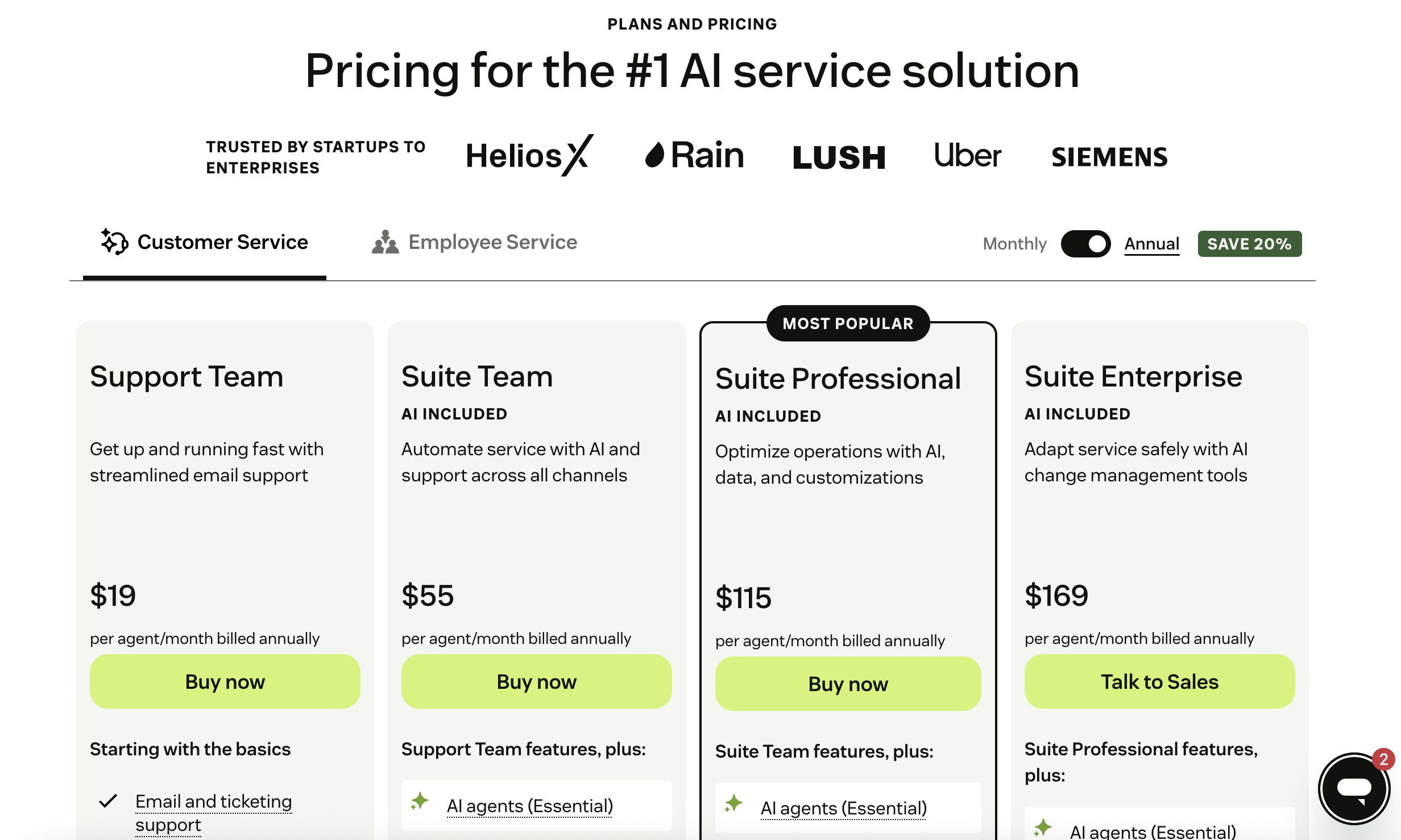
Zendesk: Seat-Based + AI Agent Outcomes
Zendesk charges traditional per-seat pricing for human agents at their standard tiers ($19-$115/seat/month). For AI agents that autonomously resolve tickets, they charge outcome-based pricing per resolution.
This hybrid recognizes that human agents and AI agents deliver value differently. Humans need software access (seats make sense), AI delivers completed work (outcomes make sense). Forcing both into one model would either underprice AI or overprice human access.
GitHub Copilot: Per-Seat + Usage Tiers
GitHub Copilot Business charges $19/developer/month for access to AI code completion. This base subscription includes standard usage. For customers using premium models or advanced features extensively, volume-based pricing kicks in.
The per-seat model works for developer tools where "who has access" matters for team coordination. But actual AI usage varies dramatically between developers—some use it constantly, others occasionally. The hybrid model captures both dimensions.
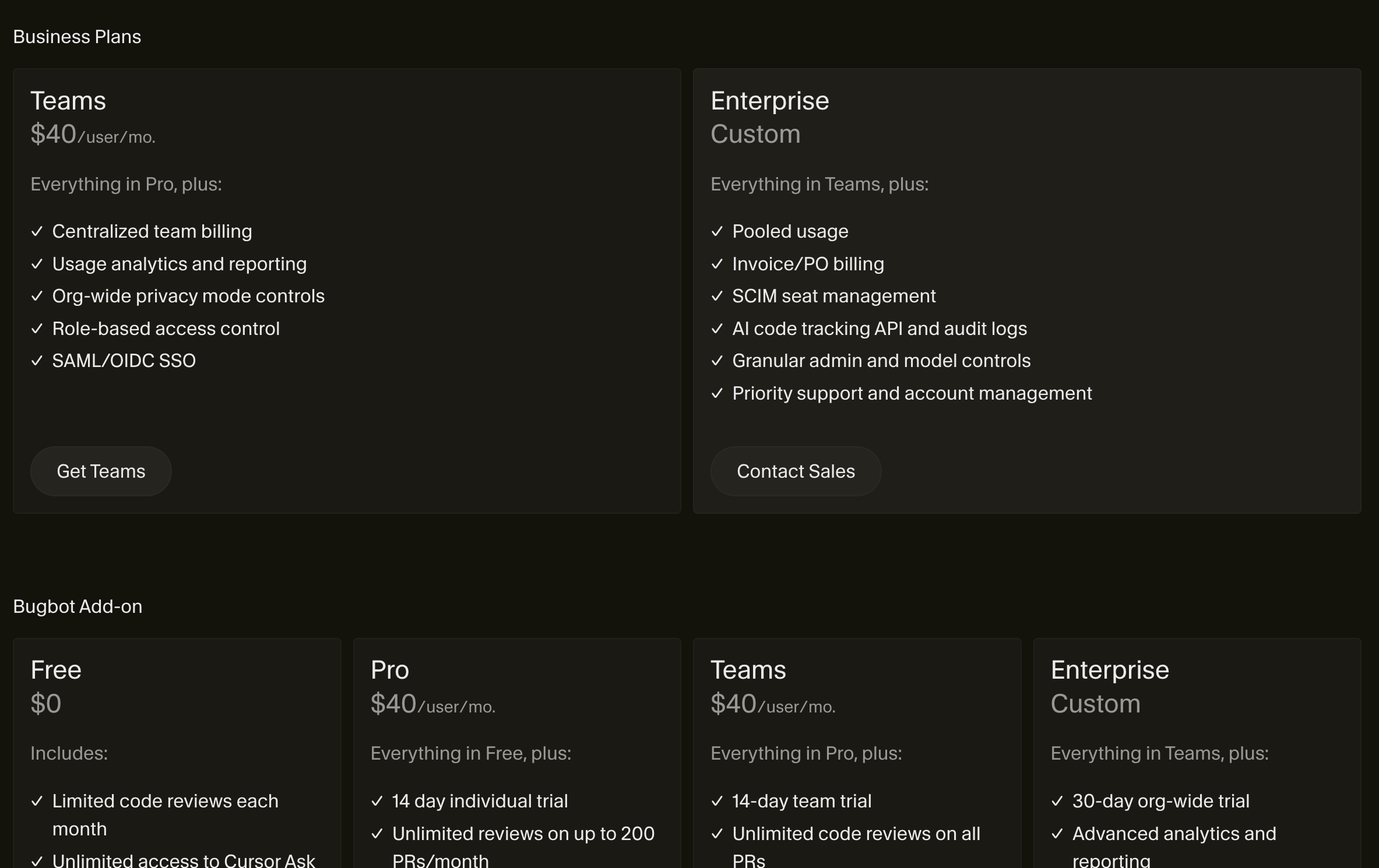
Cursor: Seat-Based + Usage Credits for Premium Models
Cursor charges $20/user/month for Pro access with 500 fast premium requests included. Beyond that, users can add usage-based charges for additional premium model access.
This hybrid structure makes Cursor accessible to developers who want to try it ($20 is approachable), provides reasonable usage for most users (500 requests covers normal usage), and monetizes power users who exhaust their allocation (usage-based overages).
OpenAI ChatGPT: Free Tier + Subscription + API Usage
OpenAI runs a multi-layered hybrid: free tier with limited GPT-3.5 access, ChatGPT Plus at $20/month with GPT-4 access and higher limits, separate API pricing at usage-based rates per token.
This serves three completely different buyer personas: consumers experimenting (free), power users wanting unlimited access (subscription), developers building applications (usage-based API).
Common Hybrid Pricing Structures
While infinite hybrid combinations exist, several patterns are emerging as best practices for AI products.
Structure 1: Base + Overages
How it works: Monthly subscription includes usage allowance, additional usage charged per unit.
Example pricing:
- Starter: $49/month (includes 5K API calls, then $0.02/call)
- Pro: $199/month (includes 25K API calls, then $0.015/call)
- Enterprise: $999/month (includes 150K API calls, then $0.01/call)
Best for: Products where most customers fit within predictable usage bands, but some exceed dramatically.
Pros: Simple to understand, provides base revenue predictability, captures expansion from heavy users.
Cons: Customers may feel "nickel and dimed" by overages, requires clear communication about limits.
Structure 2: Credits in Tiers + Top-Ups
How it works: Subscription tiers include credit allocations, customers buy additional credits as needed.
Example pricing:
- Basic: $29/month (1,000 credits, $10/1K additional)
- Professional: $99/month (5,000 credits, $8/1K additional)
- Business: $299/month (20,000 credits, $6/1K additional)
Best for: Products with multiple features at different credit costs, customers wanting spending control.
Pros: Flexible credit allocation across features, volume discounts built in, upsell path clear.
Cons: Requires explaining credit mapping, credit expiration policies can frustrate, more complex billing.
Structure 3: Seats + Usage
How it works: Per-user subscription for platform access, usage-based charges for consumption or AI features.
Example pricing:
- $49/user/month for platform access
- Plus $0.005 per AI generation
- Plus $0.10 per document processed
Best for: Products where both "who has access" and "how much they use" drive value and costs.
Pros: Familiar seat model for budgeting, usage charges align with actual AI consumption, serves different usage patterns.
Cons: Dual pricing can confuse, requires careful messaging, finance teams may resist variable components.
Structure 4: Committed Use + Overages
How it works: Customers commit to minimum annual spend, receive discounted rates, pay standard rates beyond commitment.
Example pricing:
- $50K annual commitment: 20% discount on usage rates
- $200K annual commitment: 30% discount on usage rates
- Usage beyond commitment: list price
Best for: Enterprise customers wanting predictable budgets, you wanting guaranteed revenue.
Pros: Predictable revenue, larger deal sizes, customer commitment reduces churn, volume discounts incentivize growth.
Cons: Complex to administer, requires accurate usage forecasting, may lock in customers at wrong price points.
Structure 5: Freemium + Paid Hybrid
How it works: Generous free tier with limits, paid tiers combine subscription with additional usage or outcome charges.
Example pricing:
- Free: 1,000 API calls/month
- Pro: $20/month (10,000 calls + $0.01/additional call)
- Enterprise: Custom (committed volume + overage pricing)
Best for: Developer tools, PLG products, anything where viral adoption matters.
Pros: Low-friction adoption, clear upgrade path, monetizes power users while keeping hobbyists free.
Cons: High infrastructure costs on free tier, conversion rate risk, may train customers to expect free usage.
How to Choose the Right Hybrid Model
Selecting the optimal hybrid structure depends on your product, customers, and economics.
Consider Your Cost Structure
High fixed costs, low variable costs? Lead with subscription, add usage charges only for compute-intensive features.
Low fixed costs, high variable costs? Lead with usage-based, add base subscription just to cover platform minimums.
Mixed cost structure? Match pricing to costs: seats for platform, usage for AI features.
Consider Your Customer Preferences
Enterprise customers? They want committed use discounts and predictable annual budgets. Hybrid contracts with minimums work best.
Startups and developers? They want flexibility to start small. Usage-based with low minimums or pay-as-you-go with no commitment.
Mid-market? They want some predictability with flexibility to scale. Credit packages with auto-recharge or base + overages.
Consider Your Value Metrics
Clear per-unit value? Use usage-based as primary metric with base fees for access.
Outcome-based value? Use outcome pricing as primary with base fees for platform.
Access-based value? Use subscription as primary with usage charges for expensive features only.
Consider Your Sales Motion
Self-serve PLG? Simple hybrid: subscription tiers with clear included usage and transparent overage pricing.
Sales-led enterprise? Complex hybrid: custom commitments, volume discounts, outcome-based components, negotiated terms.
Hybrid sales motion? Tiered hybrid: self-serve for SMB (simple), custom for enterprise (complex).
Consider Implementation Complexity
Simple hybrid (base + overages): Easy to implement, easy to explain, easy to forecast.
Complex hybrid (credits + outcomes + seats): Requires sophisticated billing infrastructure, harder to explain, more implementation overhead.
Start simple, add complexity only when necessary. You can always move from simple hybrid to complex hybrid as you scale.
Implementation: Building Hybrid Pricing Infrastructure
Hybrid pricing requires more sophisticated infrastructure than pure subscription or pure usage models.
What You Need to Track
Subscription data: Active subscriptions, plan levels, billing dates, committed terms.
Usage data: Real-time consumption tracking, aggregation across billing periods, accurate metering.
Credit balances: Real-time deductions, remaining balances, expiration dates, top-up history.
Outcome data: Success/failure tracking, outcome validation, charge calculations.
Customer context: Which customers are on which hybrid model, tier-specific pricing rules, custom contract terms.
Billing Complexity Multiplies
Pure subscription billing: calculate fixed charge, invoice monthly.
Pure usage billing: aggregate usage, apply rates, invoice monthly.
Hybrid billing: calculate fixed charges, aggregate usage, apply overage rates OR deduct credits, calculate outcome charges, handle multiple billing frequencies, generate combined invoices.
Each additional pricing dimension exponentially increases billing complexity. You need systems that can:
- Handle multiple pricing models simultaneously
- Apply tier-specific rules automatically
- Calculate prorations for mid-cycle changes
- Generate clear, itemized invoices
- Integrate with payment processors
- Flow data to accounting systems
Customer Communication is Critical
Hybrid pricing requires exceptional transparency to avoid confusion and disputes:
Real-time dashboards: Show subscription status, current usage, remaining credits, projected charges, and overage estimates.
Proactive alerts: Notify customers when approaching usage limits (80%, 90%, 100%), credit balances running low, or spending thresholds.
Clear documentation: Explain how each component of hybrid pricing works, provide examples, show how charges are calculated.
Itemized invoices: Break down subscription fees, usage charges, credit purchases, and outcome fees separately so customers understand what they're paying for.
Usage analytics: Show customers where their usage or credits are going, help them optimize consumption.
The Build vs. Buy Decision
Building hybrid pricing infrastructure from scratch typically takes 6-12 months:
- Metering and usage tracking systems
- Credit balance management
- Subscription management
- Usage aggregation and billing logic
- Tiered pricing rules engines
- Customer dashboards and analytics
- Invoicing and payment integration
- Contract management for custom terms
For most AI companies, this is a massive distraction from building your core product. Every month spent building billing is a month not improving your AI, shipping features, or closing deals.
Implementing Hybrid Pricing With Atlas
Atlas is purpose-built to handle the complexity of hybrid pricing models for AI companies.
Support any hybrid combination: Subscriptions + usage, credits + overages, seats + consumption, committed use + variable pricing—Atlas handles them all in one platform.
Real-time metering and credits: Track usage events, deduct credits instantly, aggregate consumption across any time period with millisecond accuracy.
Flexible pricing logic: Configure tier-specific pricing, volume discounts, overage rates, credit mappings, and outcome charges without writing code.
Customer visibility: Built-in dashboards showing subscription status, usage consumption, credit balances, projected charges, and historical analytics.
Automated billing: Calculate all components of hybrid pricing automatically—subscriptions, usage charges, credit deductions, outcome fees—and generate unified invoices.
Custom contracts: Support enterprise committed-use agreements with minimums, discounts, fungibility terms, and true-forward adjustments.
Easy transitions: Migrate customers between pricing models, grandfather legacy pricing, A/B test new hybrid structures.
With Atlas, you can launch sophisticated hybrid pricing in minutes rather than spending months building infrastructure. Configure your subscription tiers, define usage metrics, set overage pricing, and start billing customers across all dimensions of your hybrid model.
Best Practices for Hybrid Pricing Success
To maximize effectiveness of hybrid models:
Start simple, add complexity gradually: Begin with base + overages, add credits or outcomes only when needed.
Make the math transparent: Customers should easily calculate their expected bills. Provide calculators and examples.
Align hybrid components with value: Base fees should cover platform value, variable charges should map to incremental value delivered.
Communicate proactively: Alert customers before overages hit, explain charges clearly, provide visibility into consumption.
Grandfather gracefully: When changing hybrid models, give existing customers transition periods and choice.
Test pricing combinations: A/B test different hybrid structures with new customers to find optimal balance.
Monitor customer behavior: Track which customers hit overages frequently, deplete credits, or stay under limits—adjust tiers accordingly.
Provide spending controls: Let customers set budget limits, enable auto-recharge thresholds, or opt into notification-only modes.
Document everything: Explain your hybrid model thoroughly in pricing pages, contracts, and help documentation.
Train your sales team: Ensure reps can explain hybrid pricing confidently and position it as a benefit, not complexity.
Common Hybrid Pricing Mistakes to Avoid
Even successful companies make these errors when implementing hybrid models:
Making the hybrid too complex: Combining four different pricing dimensions confuses everyone. Limit to 2-3 components maximum.
Overpricing overages: If overages feel punitive, customers will under-utilize your product. Price overages fairly or offer upgrade paths.
Under-communicating usage: Customers hitting surprise overages create support nightmares and churn. Alert early and often.
Misaligning incentives: Your sales team should be compensated on total revenue (base + usage), not just initial contract value, or they'll undersell.
Ignoring customer segments: Different customer segments need different hybrid models. One-size-fits-all hybrids fit nobody perfectly.
Not planning for growth: Customers who hit overages constantly are telling you they're ready for a higher tier. Make upgrading easy.
Treating hybrid as temporary: Some companies view hybrid as a transition to pure consumption. For AI products, hybrid is often the endgame.
Forgetting about cash flow: Usage and outcome components get paid in arrears. Ensure you can fund operations with delayed revenue.
The Future of Hybrid Pricing
Hybrid pricing isn't a transitional model—it's the future of AI monetization. Here's where it's heading:
More sophisticated hybrids: Expect combinations of subscription + usage + credits + outcomes all in one offering, with AI-powered pricing recommendations.
Dynamic hybrid adjustments: Usage patterns and value delivered will trigger automatic tier changes, credit allocations, or pricing adjustments.
Personalized hybrid models: Different customers will receive customized hybrid structures based on their usage history and preferences.
Hybrid with AI optimization: AI will analyze customer usage and recommend optimal hybrid structure, predict future consumption, and suggest when to upgrade.
Regulatory clarity: As consumption pricing becomes standard, expect regulatory frameworks around hybrid pricing transparency and consumer protection.
The companies that master hybrid pricing will have a significant competitive advantage. They'll serve more customer segments effectively, align revenue with value more precisely, and build sustainable unit economics that survive AI cost volatility.
Hybrid pricing reflects the reality of AI products: they have both platform value (justifying subscriptions) and incremental value (justifying consumption charges). The sooner you embrace hybrid models, the faster you'll find the pricing structure that works for your product and customers.
Ready to launch hybrid pricing for your AI product? Atlas makes it easy to combine subscriptions, usage-based charges, credits, and outcomes in one seamless billing platform. Configure any hybrid model in minutes with real-time metering, flexible pricing logic, and automated billing. Visit runonatlas.com to get started today.