Custom Proposals for SaaS & AI Companies
What Are Custom Proposals and Why Do They Matter?
Custom proposals are tailored pricing and terms documents that sales teams create for specific customers, adapting your standard offering to meet unique business needs. Unlike one-size-fits-all pricing pages, custom proposals allow you to adjust pricing structures, add specific features, bundle services, include volume discounts, or modify payment terms for individual deals.
For SaaS and AI companies, custom proposals have become essential to closing enterprise deals, accommodating unique usage patterns, and winning competitive opportunities. The ability to quickly create and send customized offers without manual document creation or endless approval chains can be the difference between closing a deal in days versus weeks.
The challenge? Most companies are stuck with slow, manual proposal processes that create bottlenecks, introduce errors, and lose deals to faster competitors.
How Do Custom Proposals Work?
Traditional proposal workflows are painful. Sales reps identify an opportunity, manually create a document (often in Google Docs or Word), email finance for pricing approval, wait for legal to review terms, make revisions based on feedback, export to PDF, and finally send to the prospect—who might have questions that restart the entire cycle.
Modern custom proposal systems streamline this dramatically:
Define the deal parameters. Sales reps input customer information, select products or services, specify quantities, and set special terms or pricing adjustments.
System generates the proposal automatically. The platform pulls from approved templates, pricing rules, and company branding to create a complete, professional proposal in minutes.
Built-in approval workflows. The system routes proposals through the appropriate stakeholders (finance, legal, product) based on deal size, discount levels, or custom terms, ensuring compliance without manual coordination.
Send and track engagement. Proposals are shared via link rather than static PDFs, allowing real-time tracking of when prospects view the document, which sections they focus on, and when they're ready to close.
Customer accepts and signs. Electronic signature functionality enables immediate acceptance without printing, scanning, or mailing contracts.
Billing activates automatically. Once accepted, the proposal terms flow directly into your billing system, eliminating manual data entry and ensuring customers are charged correctly from day one.
This transformation from manual to automated proposal workflows typically reduces proposal creation time from hours to minutes while dramatically improving accuracy and compliance.
Why Do SaaS and AI Companies Need Custom Proposal Capabilities?
SaaS and AI products have unique characteristics that make custom proposal capabilities essential rather than optional.
Complex Pricing Models Require Flexibility
AI and SaaS products rarely fit into simple subscription tiers. You might have usage-based pricing, credit-based models, hybrid structures, committed use discounts, or outcome-based fees—often all within the same product.
Enterprise customers expect pricing tailored to their specific usage patterns, deployment needs, and budget structures. A startup using your AI API experimentally has completely different needs than an enterprise processing millions of transactions monthly.
Custom proposals allow you to accommodate this complexity without creating dozens of rigid pricing tiers or forcing customers into ill-fitting packages.
Enterprise Sales Require Customization
Enterprise deals almost always involve custom terms. They might need specific security commitments, custom SLAs, data residency requirements, payment terms that match their procurement cycles, or pricing structures that align with their fiscal year.
Standard pricing pages can't handle these nuances. Enterprise buyers expect—and frankly, demand—proposals that address their specific requirements. Without the ability to quickly create custom offers, you're simply not competitive in enterprise markets.
Speed Matters in Competitive Deals
When a prospect is evaluating three AI vendors, the first one to deliver a clear, comprehensive proposal has a significant advantage. They set the anchor for pricing expectations and demonstrate responsiveness that builds confidence.
If your proposal process takes a week while competitors deliver theirs in a day, you've already lost ground. Speed in proposal creation and delivery is a competitive weapon.
Manual Processes Create Revenue Risk
Every manual step in proposal creation introduces risk. Sales reps might apply incorrect pricing, forget to include terms that protect your margins, or make commitments your product team can't fulfill.
Manual data transfer from proposals to billing systems creates even more problems. A typo in the contract that doesn't match the billing configuration means either you're undercharging (losing revenue) or overcharging (angry customers and churn risk).
Automated custom proposal systems eliminate these errors by enforcing pricing rules, requiring approvals for exceptions, and flowing data directly into billing without human transcription.
What Should Custom Proposals Include for SaaS and AI Products?
Effective custom proposals balance comprehensiveness with clarity. Here are the essential elements:
Executive summary. A brief overview of the customer's needs and how your solution addresses them. This section should immediately demonstrate that you understand their specific challenges.
Proposed solution. Details on which products, features, or services you're recommending and why they fit the customer's use case. For AI products, this often includes model types, API access levels, or processing capabilities.
Pricing structure. Clear breakdown of costs including base fees, usage charges, credit allocations, volume discounts, and any custom pricing arrangements. Use tables or visual pricing blocks to make this scannable.
Payment terms. Billing frequency (monthly, annual, quarterly), payment methods accepted, any upfront payments or deposits required, and invoicing details.
Service level agreements. Uptime commitments, support response times, and any performance guarantees specific to this customer.
Implementation and onboarding. Timeline for getting started, any professional services included, training resources, and what the customer needs to provide.
Terms and conditions. Contract length, renewal terms, cancellation policies, data handling agreements, and any custom legal provisions negotiated for this deal.
Next steps and acceptance. Clear call-to-action explaining how to accept the proposal, what happens after acceptance, and contact information for questions.
The best proposals feel personalized without requiring hours of customization. Templating key sections while allowing flexibility on pricing and terms gives you both efficiency and personalization.
Common Questions About Custom Proposals for SaaS Companies
How do I know when to use a custom proposal vs. standard pricing?
Use custom proposals for enterprise deals, any opportunity requiring non-standard pricing or terms, deals with multiple stakeholders who need to see complete details before approval, competitive situations where personalization matters, and customers with unique technical or compliance requirements.
Use standard pricing (your pricing page with self-serve signup) for small deals, customers with straightforward needs that fit your existing tiers, product-led growth motions where friction is the enemy, and initial evaluation or trial phases before larger commitments.
Many successful SaaS companies use a hybrid approach: self-serve for small customers, custom proposals for mid-market and enterprise.
What's the difference between a proposal and a quote?
A quote is typically a shorter document focused primarily on pricing—what the customer will pay and for what products or services. Quotes are transactional.
A proposal is comprehensive, including pricing but also explaining the solution, implementation approach, business case, and complete terms. Proposals are strategic, designed to persuade and provide all information stakeholders need for approval.
For complex SaaS or AI sales, you often need both: proposals for initial deals with new customers, quotes for renewals, expansions, or add-ons with existing customers.
How much discount should I offer in custom proposals?
Discount strategy depends on deal size, customer potential, competitive dynamics, and your margin structure. General guidelines:
Volume discounts of 10-30% for committed usage at higher tiers are standard and expected. These reward customers for commitment while protecting your revenue.
Annual prepayment discounts of 10-20% are common, reflecting your reduced payment risk and improved cash flow.
Enterprise discounts for large deals can range from 20-40% off list pricing, but should be tied to meaningful commitments—multi-year contracts, committed spend minimums, or case study/reference agreements.
The key is having clear discount policies that sales reps understand and requiring approval for anything outside those bounds. Custom proposal systems can enforce these rules automatically.
How do I handle pricing for usage-based or credit-based models in proposals?
Usage-based and credit-based pricing requires clear explanation in proposals:
For usage-based pricing: Include rate cards showing per-unit costs (per API call, per token, per transaction), volume tier pricing where rates decrease at higher usage levels, estimated monthly costs based on expected usage, and overage policies if they exceed estimates.
For credit-based pricing: Specify how many credits are included in the proposed package, define what actions cost how many credits (credit mapping), explain credit expiration if applicable, and describe top-up or renewal processes.
The goal is transparency. Customers should be able to estimate their costs based on expected usage patterns. Including usage calculators or worked examples helps tremendously.
Can I include free trials or pilot programs in custom proposals?
Absolutely. Free trials and pilot programs are powerful sales tools in custom proposals, especially for AI products where customers want to validate accuracy, performance, and fit before committing.
Structure pilots clearly: define exact duration (30 days, 90 days), specify what's included (features, usage limits, support level), set success criteria or milestones, and outline transition to paid terms after the pilot.
Pilots should feel like genuine evaluation opportunities, not just delayed payment. The best pilots have clear objectives both sides agree on upfront.
How do I speed up internal approvals for custom deals?
Slow internal approvals kill deals. Here's how to accelerate:
Define clear approval thresholds. Deals under certain discount levels or contract values can be auto-approved. Anything outside bounds routes to appropriate stakeholders automatically.
Use automated workflows. Modern proposal systems route deals to the right people based on rules, rather than sales reps manually emailing around.
Provide all context upfront. When finance or legal receives a proposal for review, they should see the deal rationale, competitive context, and risk assessment—not just the pricing sheet.
Set approval SLAs. Teams should commit to reviewing proposals within 24-48 hours. This becomes easier when proposals are standardized and systems flag what's unusual about a deal.
Empower sales on standard deals. If a deal follows your standard pricing and terms with approved discounts, sales should be able to send it without waiting for approvals.
What happens after a customer accepts a custom proposal?
Post-acceptance workflow matters enormously:
Automated billing setup. The proposal terms should flow directly into your billing system, creating the customer account with correct pricing, usage limits, and billing schedule.
Kickoff and onboarding. Customer success or implementation teams are notified to begin onboarding based on the proposal timeline.
Contract storage. The signed proposal becomes the legal contract and is stored securely for reference.
Revenue recognition. Finance systems are updated to recognize revenue according to the deal terms.
Manual handoffs between systems are where errors creep in. Integration between your proposal system and billing platform is critical.
How do I track proposal effectiveness and win rates?
Track these metrics to optimize your proposal process:
Time to proposal: How long from opportunity identification to proposal sent. Faster is better.
Proposal to close time: How long from proposal sent to deal closed. Shorter cycles mean more efficient sales.
Proposal view rates: What percentage of recipients actually open and view proposals. Low rates might indicate targeting problems.
Win rates by proposal type: Which proposal structures, pricing models, or terms close at higher rates. This tells you what resonates.
Discount levels vs. win rates: Whether higher discounts actually improve close rates (often they don't).
Common objections: What questions or pushback you get most frequently, indicating where proposals need improvement.
Modern proposal systems provide analytics on all these dimensions, turning what was opaque into actionable data.
How Do Custom Proposals Impact Revenue Growth?
Custom proposals aren't just a sales tool—they're a revenue driver when implemented well.
Faster Sales Cycles
Companies that implement automated custom proposal systems report 30-50% reductions in time from opportunity to close. When you can deliver a comprehensive, professional proposal in hours instead of days, deals move faster through the pipeline.
Faster cycles mean your sales team can handle more opportunities simultaneously, improving overall productivity and revenue capacity.
Higher Win Rates
Personalized proposals demonstrate that you understand the customer's specific needs. This isn't just feel-good psychology—it materially impacts win rates.
Sales teams report 15-25% improvements in win rates when moving from generic to customized proposals, especially in competitive deals where differentiation matters.
Larger Deal Sizes
Custom proposals enable you to confidently present larger deals. When you can clearly articulate pricing for higher tiers, volume discounts, and multi-year commitments, customers are more likely to commit to bigger packages.
The ability to present multiple options (good, better, best) in proposals also drives upsells. Customers often choose the middle option, which is typically 30-50% more revenue than your base offering.
Reduced Revenue Leakage
Manual proposal processes leak revenue in multiple ways: incorrect pricing that leaves money on the table, forgotten upsells or cross-sells, terms that don't protect margins, and billing errors from manual data entry.
Automated systems enforce pricing rules, suggest relevant upsells, require approvals for margin-threatening discounts, and ensure billing matches what was sold—eliminating these common sources of leakage.
Improved Forecasting Accuracy
When proposals are standardized and tracked systematically, sales forecasting becomes dramatically more accurate. You can see which stage deals are at, what pricing they're considering, and historical conversion rates for similar proposals.
Better forecasting enables better resource planning, more confident hiring decisions, and clearer communication with investors or stakeholders about future revenue.
Building vs. Buying Custom Proposal Infrastructure
Many SaaS companies initially build custom proposal systems internally. The thinking is: "We have specific needs, we have engineers, how hard can it be?"
The reality: building proposal infrastructure is deceptively complex and becomes a massive time sink.
What Building Custom Proposal Systems Actually Requires
Document generation engine that creates professional PDFs or interactive documents from templates, with dynamic content population, branded design, and responsive formatting.
Pricing configuration logic that handles your specific pricing models (usage-based, credit-based, hybrid), applies volume discounts correctly, enforces margin requirements, and calculates taxes and fees.
Approval workflow system that routes proposals to appropriate stakeholders based on rules, tracks approval status, sends reminders for pending reviews, and logs approval history for compliance.
Customer-facing portal where prospects can view proposals, ask questions, accept terms, and sign electronically.
Electronic signature integration with legal compliance for various jurisdictions, identity verification, and secure document storage.
Billing system integration that flows proposal data into your billing platform accurately, handles complex pricing structures, and syncs customer data.
Analytics and tracking showing proposal performance, engagement metrics, win rates, and revenue attribution.
Security and compliance meeting SOC 2, GDPR, and enterprise security requirements.
Building all this from scratch typically takes 6-12 months of engineering time, ongoing maintenance as requirements change, and distracts your team from building your core product.
When to Build vs. Buy
Build internally when: Your pricing is so unique that no existing platform can handle it, you have excess engineering capacity and proposal infrastructure is strategic, or you're already building a full deal desk or CPQ system for other reasons.
Buy a platform when: You need custom proposals working in weeks not months, your engineering team should focus on core product, you want battle-tested proposal infrastructure with security and compliance built in, or you need integration with billing, CRM, and other systems.
For most SaaS and AI companies, buying makes far more sense. The ROI from faster deals and higher win rates pays for proposal software within weeks.
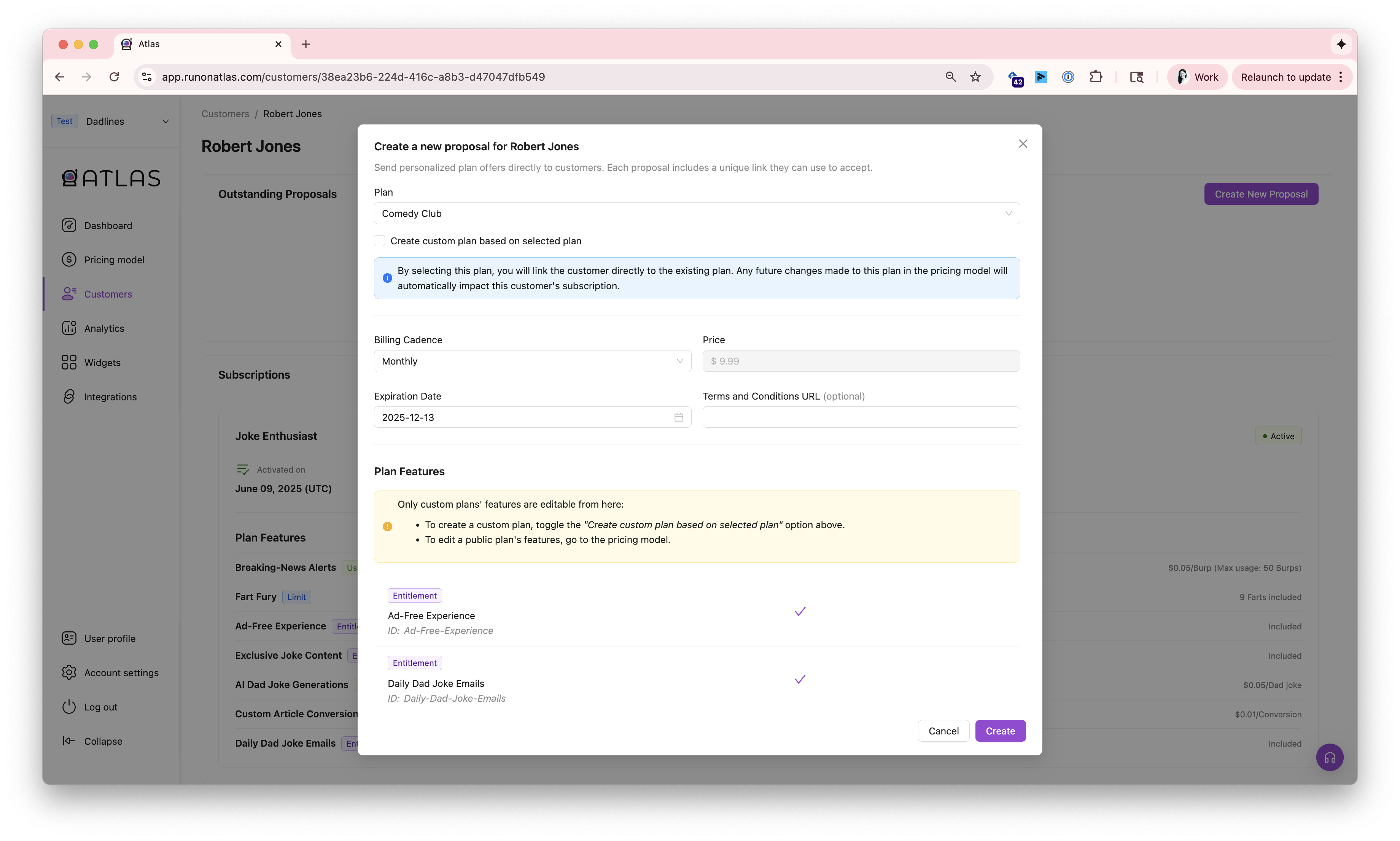
Atlas Custom Proposals: Built for Modern SaaS and AI Companies
Atlas just launched custom proposals specifically designed for SaaS and AI companies selling consumption-based products.
Create proposals in minutes, not hours. Set pricing, terms, and credits directly in Atlas without leaving your billing platform. No manual documents, no spreadsheet gymnastics.
Support any pricing model. Whether you're using usage-based pricing, credit-based systems, hybrid models, or complex enterprise structures, Atlas handles it natively.
Built-in flexibility. Adjust pricing and terms on the fly for specific deals. Add volume discounts, custom billing schedules, or special provisions without rebuilding templates.
Streamlined workflows. Create, approve, and send proposals all in one place. Your team stays aligned and deals move faster.
Automatic billing integration. When customers accept proposals, their pricing and terms flow directly into billing. No manual data entry, no configuration errors.
Real-time tracking. See when prospects view proposals, which sections they focus on, and when they're ready to close.
Atlas understands that modern SaaS and AI companies need proposal infrastructure that matches their pricing complexity. We built custom proposals to be as flexible as your pricing models while being dramatically simpler to use than building your own system or using generic proposal software.
Best Practices for Custom Proposals
To maximize effectiveness of your custom proposal process:
Keep proposals concise. Aim for 3-5 pages maximum. Busy executives won't read 20-page documents. Be comprehensive but ruthlessly concise.
Lead with value, not features. Start with the customer's problem and how you solve it. Pricing and features come after you've established why they need you.
Use visual pricing tables. Don't bury pricing in paragraphs. Clean, scannable tables make it easy to understand costs at a glance.
Include multiple options when appropriate. Presenting good/better/best choices drives upgrades and gives customers a sense of control.
Personalize without overthinking. Use the customer's name, reference their specific use case, and customize pricing—but don't spend hours wordsmithing every sentence.
Make acceptance frictionless. Electronic signatures, clear next steps, and simple acceptance processes convert at much higher rates than "print, sign, scan" workflows.
Follow up strategically. When you can see that a prospect opened your proposal but hasn't responded, that's the perfect time to reach out and answer questions.
Test and iterate. Track which proposal structures, pricing presentations, and terms close at higher rates. Continuously refine based on data.
Train your team thoroughly. Sales reps need to understand your pricing models, approval thresholds, and when custom proposals are appropriate vs. standard pricing.
The Future of Custom Proposals in SaaS
Proposal technology is evolving rapidly, and AI is accelerating the transformation:
AI-generated proposal content that adapts messaging to specific industries, use cases, and stakeholders while maintaining your brand voice.
Predictive pricing suggestions based on historical data, helping reps price deals optimally for both revenue and win rate.
Intelligent approval routing that uses machine learning to determine which deals need which approvals, reducing unnecessary friction.
Automated negotiation support providing reps with real-time suggestions for objection handling and counteroffer pricing.
Dynamic ROI calculators embedded in proposals that let prospects model their specific usage and see projected value.
The companies winning in SaaS and AI will be those that treat proposals not as administrative paperwork but as strategic revenue tools—powered by technology that makes creating customized offers as easy as clicking a button.
Start Closing Deals Faster With Custom Proposals
Custom proposals are no longer optional for SaaS and AI companies. Enterprise customers expect them, competitive dynamics demand them, and complex pricing models require them.
The question isn't whether you need custom proposal capabilities—it's whether you'll build a slow manual process or implement modern infrastructure that accelerates deals.
Every day you spend with manual proposal creation is a day your sales team is slower than competitors, your deals take longer to close, and your revenue growth is constrained by administrative friction.
Modern proposal infrastructure pays for itself immediately through faster sales cycles, higher win rates, and eliminated revenue leakage.
Ready to launch custom proposals for your SaaS or AI product?
Atlas makes it easy to create and send tailored deals in minutes with flexible pricing, built-in approval workflows, and automatic billing integration. Set pricing, terms, and credits without leaving your billing platform. Visit Atlas or book a demo to get started today.